
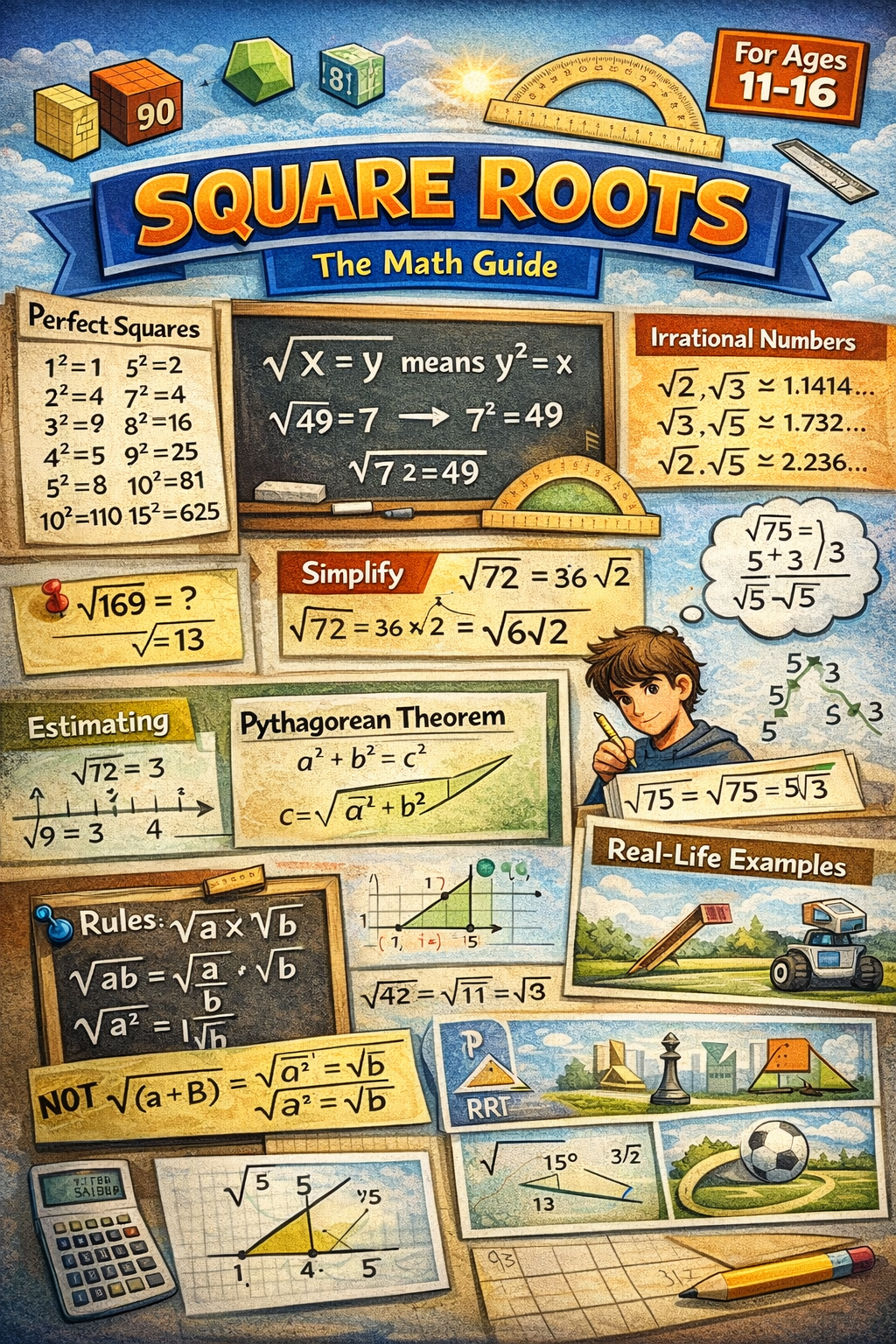
Square roots have a reputation. Some people see that √ symbol and instantly feel like math just got “serious.” But here’s the hard truth: square roots aren’t scary—they’re just a tool. Once you understand what they mean and learn a few rules, they become one of the most powerful shortcuts in your math toolbox.
Square roots show up in:
- Finding the side length of a square when you know its area
- Solving right triangle problems (Pythagorean theorem)
- Calculating distance on a coordinate plane
- Science formulas (speed, energy, waves)
- Geometry, algebra, and even coding and game physics
So yes: square roots are basically the “multi-department KPI” of math—high impact, everywhere.
Let’s break them down in a way that makes sense.
1) What is a square root?
A square root answers this question:
“What number multiplied by itself gives this number?”
If √x = y, that means y² = x.
Example:
- √25 = 5 because 5² = 25
- √36 = 6 because 6² = 36
- √1 = 1 because 1² = 1
- √0 = 0 because 0² = 0
Why is it called a “square” root?
Because it connects directly to squares in geometry.
If a square has side length s, its area is s².
So if you know the area and want the side length, you take the square root:
s = √(area)
Example:
If a square’s area is 49 cm², the side length is √49 = 7 cm.
2) Perfect squares: the easiest square roots
A perfect square is a number that comes from squaring a whole number.
Here are the ones you should know cold (they show up constantly):
- 1² = 1
- 2² = 4
- 3² = 9
- 4² = 16
- 5² = 25
- 6² = 36
- 7² = 49
- 8² = 64
- 9² = 81
- 10² = 100
- 11² = 121
- 12² = 144
- 13² = 169
- 14² = 196
- 15² = 225
- 16² = 256
- 20² = 400
- 25² = 625
If you recognize these quickly, square-root problems become faster and easier.
Mini-challenge:
Without a calculator, what is √169? (Answer: 13)
3) Principal square root: why √x is usually positive
Here’s a key idea that confuses many students at first:
- The equation y² = 25 has two solutions: y = 5 and y = −5
Because (5)² = 25 and (−5)² = 25.
But when we write √25, we mean the principal square root, which is the positive root.
So:
- √25 = 5 (not −5)
However:
- If you solve y² = 25, then y = ±5.
Business translation: √25 is the “default setting” (positive). Solving an equation is the “full analysis” (both solutions).
4) Square roots and negative numbers (real vs complex)
In real numbers (the numbers you normally use in school), you cannot take the square root of a negative number.
Because:
- Any real number squared is nonnegative.
Examples: - 3² = 9
- (−3)² = 9
- 0² = 0
So squares never go below 0.
That means:
- √(−9) is not a real number.
Later (usually in more advanced math), you learn imaginary numbers:
- √(−1) = i
But for ages 11–16 (in standard curricula), the safe rule is:
✅ You can take square roots of 0 or positive numbers in real math.
❌ Negative numbers under the root are “not real” (unless you’ve started complex numbers).
5) Estimating square roots (when it’s not a perfect square)
What if you have √50 or √20? These aren’t perfect squares. You estimate.
Step-by-step estimation
- Find the closest perfect squares around the number.
- Place the square root between the roots of those squares.
- Refine the estimate.
Example: √50
Closest perfect squares:
- 49 = 7²
- 64 = 8²
So √50 is between 7 and 8, and very close to 7 because 50 is close to 49.
A decent estimate: √50 ≈ 7.07
Example: √20
Closest perfect squares:
- 16 = 4²
- 25 = 5²
So √20 is between 4 and 5, closer to 4.
A decent estimate: √20 ≈ 4.47
Mini-challenge:
Estimate √90. (Hint: between 9² and 10²)
6) Simplifying square roots: turning messy into manageable
Simplifying means rewriting a square root in a cleaner form.
Example:
√72 looks messy. But it can become simpler.
The key idea
If the number inside the root has a perfect square factor, you can pull it out.
Because:
√(a·b) = √a · √b (when a and b are nonnegative)
Example: √72
Factor 72:
72 = 36 × 2
So:
√72 = √(36×2) = √36 · √2 = 6√2
That’s simplified.
Another example: √75
75 = 25 × 3
√75 = √25 · √3 = 5√3
A quick method: find the biggest square factor
Common square factors: 4, 9, 16, 25, 36, 49, 64, 81, 100…
If you train your eyes to spot them, simplifying gets fast.
Mini-challenge:
Simplify √98.
Hint: 98 = 49×2 → √98 = 7√2
7) Prime factorization method (the “always works” approach)
When the number is big or tricky, prime factorization is your reliable process.
Steps
- Prime-factor the number inside the root.
- Pair up identical primes.
- Each pair comes out as one number.
Example: √180
Prime factorization:
180 = 2² × 3² × 5
So:
√180 = √(2² × 3² × 5)
= 2 × 3 × √5
= 6√5
Example: √200
200 = 2³ × 5²
Pairs: 2² and 5²
So:
√200 = √(2² × 5² × 2)
= 2 × 5 × √2
= 10√2
This is the “structured workflow” version of simplifying.
8) Rules of square roots (what’s true, what’s not)
8.1) Multiplication rule (usually true)
If a ≥ 0 and b ≥ 0:
√(ab) = √a · √b
Example:
√(9×16) = √144 = 12
√9 · √16 = 3·4 = 12 ✅
8.2) Division rule (usually true)
If a ≥ 0 and b > 0:
√(a/b) = √a / √b
Example:
√(49/4) = √49 / √4 = 7/2 ✅
8.3) The absolute value rule
√(a²) = |a|
This is important because √x is defined to be nonnegative.
Example:
√((-7)²) = √49 = 7, not −7
So it equals |−7| = 7.
8.4) The BIG trap (not true)
❌ √(a + b) = √a + √b is NOT generally true.
Example:
√(9 + 16) = √25 = 5
But √9 + √16 = 3 + 4 = 7
5 ≠ 7 ❌
This mistake is common. Avoid it like a pop-up scam.
9) Adding and subtracting radicals
You can only add/subtract radicals if they are like terms (same radical part).
Example:
3√2 + 5√2 = 8√2 ✅
But:
3√2 + 5√3 cannot be combined (different radicals).
Also:
√8 can be simplified first:
√8 = √(4×2) = 2√2
So:
√8 + √2 = 2√2 + √2 = 3√2 ✅
Strategy: Always simplify radicals before adding/subtracting.
10) Multiplying radicals
Multiply the numbers and the radicals, then simplify.
Example:
(3√5)(2√10)
= 3×2 × √(5×10)
= 6√50
= 6√(25×2)
= 6×5√2
= 30√2
This is very common in algebra.
11) Square roots in equations (solving step by step)
Example 1: x² = 49
x = ±7
Example 2: x² = 20
x = ±√20 = ±2√5
Example 3: (x − 3)² = 16
Take square root of both sides:
x − 3 = ±4
So:
x = 3 ± 4
x = 7 or x = −1
Common mistake: forgetting the ± when solving.
Square root symbol gives the positive root, but solving x² = k gives two solutions.
12) Irrational numbers: why √2 is special
Some square roots are clean integers (perfect squares). Others are decimals that never end and never repeat.
Those are irrational numbers.
Examples:
- √2 ≈ 1.414213562…
- √3 ≈ 1.732050807…
- √5 ≈ 2.2360679…
They don’t become a repeating pattern like 1/3 = 0.3333…
Why √2 is famous
Because it was one of the first numbers people proved was irrational. It appears everywhere:
- Diagonal of a 1×1 square is √2
- Right triangles with equal legs
- Geometry and coordinate distances
Irrational numbers are not “bad.” They’re just “non-terminating, non-repeating.” In real life, we approximate them.
13) Square roots in geometry (where they really shine)
13.1) Pythagorean theorem (right triangles)
For a right triangle with legs a and b and hypotenuse c:
a² + b² = c²
So:
c = √(a² + b²)
Example:
a = 6, b = 8
c = √(36 + 64) = √100 = 10
This is one of the biggest reasons square roots matter.
13.2) Distance formula (coordinate plane)
Distance between (x₁, y₁) and (x₂, y₂):
d = √[(x₂−x₁)² + (y₂−y₁)²]
This is basically Pythagorean theorem in coordinate form.
Example:
(1,2) to (5,5):
d = √[(4)² + (3)²] = √(16+9)=√25=5
13.3) Diagonal of a square
If a square has side s, diagonal d:
d = s√2
Example:
s=10 → d=10√2 ≈ 14.14
14) Square roots and area: reversing squaring
If area = s², then s = √area. This shows up in many problems.
Example:
A square has area 196 cm². Side length?
s = √196 = 14 cm
Example:
A square has area 50 m². Side length?
s = √50 = √(25×2) = 5√2 ≈ 7.07 m
This is a classic real-life context: floor tiles, gardens, screen sizes, and more.
15) Rationalizing the denominator (advanced but common)
Sometimes you get answers like:
3/√5
Teachers often want no radicals in the denominator. So we “rationalize” by multiplying top and bottom by √5:
3/√5 × √5/√5 = 3√5/5
This keeps the value the same but cleans the form.
Another example:
5/(2√3) → multiply by √3/√3:
= 5√3 / (2×3)
= 5√3/6
If you haven’t reached this unit yet, treat it as a preview. If you have, this is a must-know.
16) Common mistakes (so you stop losing easy points)
- Forgetting the ± when solving x² = k
Equation solutions include both positive and negative. - Thinking √(a+b) = √a + √b
Not true in general. - Not simplifying first
√8 + √2 is not “√10.” Simplify √8 first. - Messing up √(a²)
It’s |a|, not a. - Cancelling incorrectly
√(a/b) = √a/√b is fine (for nonnegative a and positive b), but don’t split sums. - Using decimals too early
If the exact answer is 5√2, keep it exact unless asked to approximate.
17) The “Square Root Playbook” for tests
When you see a square root problem, run this plan:
- Is it a perfect square?
If yes, compute quickly. - If not, can I simplify?
Look for square factors (4, 9, 16, 25, 36…). - If it’s an equation:
Remember ± when appropriate. - If it’s geometry:
Check if it’s Pythagorean theorem or distance formula. - Sanity check:
- √x must be nonnegative (principal root)
- √x gets bigger as x gets bigger
- √x is between the roots of nearby perfect squares
This approach saves time and reduces mistakes.
18) Practice section (with answers)
A) Perfect squares
- √81 = 9
- √144 = 12
- √225 = 15
B) Simplify
- √48 = √(16×3) = 4√3
- √72 = 6√2
- √125 = √(25×5) = 5√5
- √300 = √(100×3) = 10√3
C) Add/subtract
- 2√5 + 7√5 = 9√5
- √18 + √8 = 3√2 + 2√2 = 5√2
D) Solve
- x² = 64 → x = ±8
- (x+2)² = 49 → x+2 = ±7 → x = 5 or x = −9
E) Geometry
- Right triangle legs 9 and 12: c = √(81+144)=√225=15
- Distance between (−2,1) and (4,5): √(6²+4²)=√(36+16)=√52=2√13
19) Real-world connections (future-proof skills)
Square roots aren’t just a school topic. They show up in:
- Engineering: lengths, forces, stability, diagonals
- Physics: speed formulas, energy, wave math
- Computer graphics: distance calculations, lighting, collisions
- Data science: standard deviation involves square roots
- Architecture: diagonal supports and scaling
- Navigation: shortest paths and coordinate distance
Learning square roots is like learning a universal adapter: it plugs into multiple subjects.
20) Quick recap: what you should remember most
- √x is the positive number whose square is x (principal root).
- Perfect squares are your fast wins.
- Simplify radicals by pulling out square factors.
- √(ab) = √a√b (nonnegative inputs), but √(a+b) ≠ √a + √b.
- Solving x² = k gives ±√k.
- Pythagorean theorem and distance formula are square-root machines.