
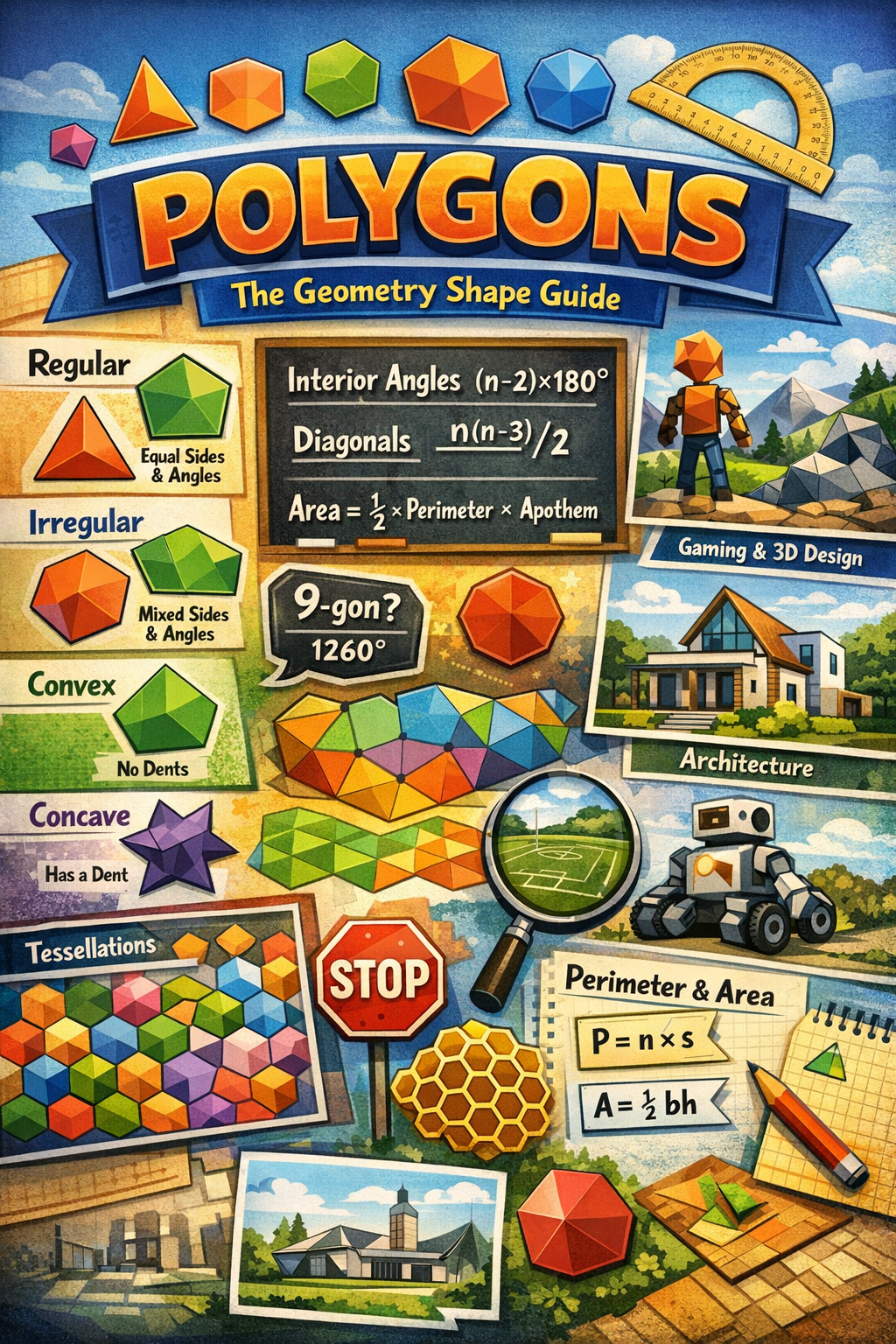
If circles are the smooth “VIPs” of geometry, polygons are the hardworking project managers: straight edges, clear corners, and everything nicely measurable. Polygons show up everywhere—road signs, soccer fields, Minecraft builds, logos, floor tiles, and the 3D graphics in your favorite games. When you learn polygons, you’re not just memorizing shapes; you’re upgrading your ability to spot patterns, reason logically, and calculate like a pro.
This guide is designed for students from about 11 to 16. It starts simple and levels up gradually. You’ll get definitions, naming rules, classifications, the most important angle and diagonal formulas, and practical area tricks. You’ll also get mini-challenges to test yourself and real-world links to design and tech, because math is way more interesting when it has a job to do.
1) What exactly is a polygon?
A polygon is a flat (two-dimensional) shape that is:
- Made only of straight line segments (no curved edges),
- Closed (the segments connect end to end and return to the starting point),
- Non-self-crossing in its standard form (we usually talk about “simple” polygons first).
Think of it like drawing a path with a ruler: you draw a straight line, turn, draw another straight line, and eventually you come back to where you began. The corners where you turn are called vertices (singular: vertex). The straight pieces are sides (or edges).
Not polygons:
- A circle (curved boundary),
- A shape with a curved side (part circle, part line),
- A “shape” that doesn’t close (an open chain),
- A star shape where edges cross each other (this can be a polygon in a broader definition, but in school math we usually start with simple polygons).
A polygon must have at least 3 sides. The smallest polygon is a triangle. That’s not a coincidence: triangles are the basic “building blocks” of polygon math. In fact, many polygon formulas are secretly triangle formulas wearing a fancy hat.
2) Naming polygons: the side-count language
Polygons are named by how many sides they have. Here are the key ones you should know:
- 3 sides: triangle
- 4 sides: quadrilateral
- 5 sides: pentagon
- 6 sides: hexagon
- 7 sides: heptagon
- 8 sides: octagon
- 9 sides: nonagon (also called enneagon)
- 10 sides: decagon
- 11 sides: hendecagon (sometimes undecagon)
- 12 sides: dodecagon
- 20 sides: icosagon
After that, names exist (and get tongue-twisty). The important part is the idea: “n-gon” means “n sides.” If you know n, you can do the math.
Mini-challenge:
Look around your room or street. Can you find a hexagon? (Hint: honeycomb patterns, some bolts/nuts, some tiles.) Can you find an octagon? (Stop signs in many countries.)
3) Regular vs irregular: “same everything” vs “mixed”
This is one of the biggest classification ideas.
Regular polygon:
- All sides are equal length,
- All interior angles are equal.
Examples: equilateral triangle, square, regular pentagon, regular hexagon.
Irregular polygon:
- Sides are not all equal and/or angles are not all equal.
Regular polygons are the “clean spreadsheet” version of shapes: consistent, predictable, and easier to calculate because one measurement can unlock many others.
Why regular polygons matter:
- They tile and pattern beautifully,
- They appear in design, engineering, and digital modeling,
- Their symmetry makes them great for math problems.
4) Convex vs concave: “no dents” vs “has a dent”
Convex polygon:
- All interior angles are less than 180°,
- If you draw a line between any two points inside it, the line stays inside.
Concave polygon:
- Has at least one interior angle greater than 180°,
- Looks like it has a “dent” or inward bend.
A quick test:
Pick any two points inside the shape. If you can connect them with a straight line that never leaves the shape, it’s convex. If some line escapes outside, it’s concave.
Why you care:
Concave polygons can be trickier for area and diagonals, and they’re common in real layouts (like rooms with a notch or game map boundaries).
5) Interior and exterior angles: the polygon’s “turning plan”
Angles are where polygons get powerful, because angles are the rules of turning.
- Interior angle: the angle inside the polygon at a vertex.
- Exterior angle: the angle you get when you extend one side and measure the “outside turn” to the next side.
Magic fact (convex polygons):
If you walk around the polygon and measure the exterior angles (the turn each time), the total is always 360°. That’s a fixed “budget”: one full rotation.
5.1) Interior angle sum formula
For a polygon with n sides, the sum of all interior angles is:
Sum = (n − 2) × 180°
Why (n − 2)? Because you can divide any convex polygon into (n − 2) triangles by drawing diagonals from one vertex. Each triangle has 180°, so total is (n − 2)×180°.
Examples:
- Triangle (n=3): 180°
- Quadrilateral (n=4): 360°
- Pentagon (n=5): 540°
- Hexagon (n=6): 720°
Mini-challenge:
A polygon has interior angles that add up to 1080°. How many sides does it have?
Hint: 1080 = (n−2)×180 → divide by 180 first.
5.2) One interior angle in a regular polygon
If the polygon is regular, all angles are equal:
Each interior angle = [(n − 2) × 180°] / n
Example: regular hexagon (n=6)
Each angle = 720/6 = 120°
5.3) Exterior angle in a regular polygon
Total exterior angles = 360°, so:
Each exterior angle = 360° / n
And (for convex polygons):
Interior = 180° − (360°/n)
Example: regular pentagon (n=5)
Exterior = 360/5 = 72°
Interior = 180 − 72 = 108°
This is a great shortcut: sometimes it’s easier to work with 360 than with (n−2)×180.
6) Diagonals: connections that reveal triangles
A diagonal is a line segment connecting two non-adjacent vertices. Diagonals matter because they:
- Divide polygons into triangles,
- Help with structural strength (think bridges),
- Show up in formulas.
Number of diagonals in an n-gon:
Diagonals = n(n − 3) / 2
Reason: from each vertex you can connect to n−3 non-neighbors; each diagonal gets counted twice, so divide by 2.
Check:
- Pentagon (n=5): 5(2)/2 = 5 diagonals
- Hexagon (n=6): 6(3)/2 = 9 diagonals
Mini-challenge:
How many diagonals does a decagon have?
7) Perimeter: the polygon’s “price tag”
Perimeter is the distance around the polygon. Think of it as cost: if you were building a fence, perimeter is how much fence you must buy.
- Perimeter of any polygon: add all side lengths.
- Perimeter of a regular polygon: Perimeter = n × s (s = one side)
Practical tip: If it says “each side is 7 cm” and it’s a 9-gon, don’t overthink it. Perimeter = 9×7 = 63 cm. KPI delivered.
8) Area: how much space is inside?
Area is the amount of surface inside the polygon. This is the “capacity” metric: how much floor space, how much paper, how much screen real estate.
8.1) Triangle area (the core engine)
Area = (1/2) × base × height
Triangles are the foundation. If you can triangulate a polygon, you can compute area.
8.2) Quadrilaterals: the four-side family
Rectangle: Area = length × width
Square: Area = s²
Parallelogram: Area = base × height (perpendicular height!)
Rhombus: Area = (d1 × d2) / 2 (or base × height)
Kite: Area = (d1 × d2) / 2
Trapezoid: Area = (1/2) × (sum of parallel sides) × height
Mini-challenge:
A trapezoid has parallel sides 10 cm and 16 cm, and height 7 cm. What’s the area?
8.3) Regular polygons: the apothem trick
For any regular polygon:
Area = (1/2) × perimeter × apothem
The apothem is the distance from the center to the midpoint of a side (a perpendicular line).
Why it works: a regular polygon splits into n equal triangles, each with base = side length and height = apothem. Add them up and you get the formula.
8.4) Triangulation for any convex polygon
When there’s no direct formula:
- Pick one vertex,
- Draw diagonals to split into triangles,
- Find each triangle’s area,
- Add.
It’s geometry’s version of “break a big project into smaller tasks.”
9) Coordinates: polygons on a grid (next level)
If vertices are points (x, y), you can still find:
Perimeter: use the distance formula between consecutive vertices and add them up (don’t forget the last point back to the first).
Distance between (x1, y1) and (x2, y2):
d = √[(x2−x1)² + (y2−y1)²]
Area (advanced): the “shoelace formula” (explained later) computes area from coordinates in a consistent pattern—very useful in coding and graphics.
10) Special polygons you should recognize fast
Triangles:
- Equilateral: all sides equal, all angles 60°
- Isosceles: two sides equal, base angles equal
- Scalene: all sides different
- Right triangle: has a 90° angle
Quadrilaterals:
- Square: all sides equal, all angles 90°
- Rectangle: opposite sides equal, all angles 90°
- Parallelogram: opposite sides parallel, opposite angles equal
- Rhombus: all sides equal, opposite angles equal
- Kite: two pairs of adjacent equal sides
- Trapezoid: at least one pair of parallel sides
Pentagon/hexagon/octagon: know the names and recognize common appearances (like octagonal stop signs).
11) Polygons in real life: geometry with a paycheck
Polygons are quietly running the world:
Architecture & construction:
Floor plans are polygons. Rooms are rectangles or irregular polygons. Roof trusses use triangles for stability.
Engineering:
Bridges use triangular frameworks because triangles don’t “wiggle” without changing side lengths. Many machine parts have polygonal faces.
Design & branding:
Logos use polygons to feel stable (squares), dynamic (triangles), or balanced (regular shapes). Patterns in packaging often rely on tiling.
Computer graphics & video games:
3D models are built from polygons, especially triangles. “Low-poly style” is literally an artistic choice to use fewer polygons.
Robotics & navigation:
Robots map spaces with boundaries; polygons make path calculations efficient.
So yes: polygons are the backstage crew of modern life—doing everything important while staying out of the spotlight.
12) Tessellations: when polygons tile the plane
A tessellation covers a surface completely with no gaps and no overlaps.
Regular polygons that tessellate by themselves:
- Equilateral triangles (60°; 6 fit around a point)
- Squares (90°; 4 fit)
- Regular hexagons (120°; 3 fit)
Regular pentagons don’t tessellate alone because 108° doesn’t divide 360° evenly.
Mini-challenge:
If a regular polygon tessellates by itself, then 360° must be divisible by its interior angle. Test n=3,4,6.
13) Common mistakes (and how to avoid them)
- Confusing side count with angle count
Sides = vertices = interior angles. Keep the trio together. - Mixing interior and exterior angles
Exterior angles add to 360°. For regular polygons, exterior = 360/n. - Using the wrong height
Height in area formulas is perpendicular distance—not the slanted side. - Forgetting to close the shape
Perimeter from coordinates must include last-to-first distance. - Assuming “regular” without being told
If it doesn’t say regular, treat it as irregular.
Geometry is quality control: small errors become big problems, but good checks catch them early.
14) Mini practice set (with quick solutions)
- Interior angle sum of a 9-gon:
(9−2)×180 = 1260° - Each interior angle of a regular octagon:
[(8−2)×180]/8 = 135° - Each exterior angle of a regular decagon:
360/10 = 36° - Diagonals in a hexagon:
6×3/2 = 9 - Perimeter of a regular pentagon with side 12 cm:
5×12 = 60 cm - Area of a parallelogram with base 14 and height 5:
14×5 = 70 - Area of a rhombus with diagonals 10 and 8:
(10×8)/2 = 40
Once you pick the right formula, it becomes plug-and-play.
15) A fast “polygon decision tree” for tests
A) What is n?
B) Is it regular? (If yes, symmetry shortcuts unlock.)
C) Is it about angles, diagonals, perimeter, or area?
- Angles → (n−2)×180 or 360/n
- Diagonals → n(n−3)/2
- Perimeter → add sides or n×s
- Area → special formula, triangulate, or ½×perimeter×apothem (regular)
D) Sanity check
Angles shouldn’t be negative. Perimeter > any single side. Area units are squared.
16) Polygons and the future: why this matters beyond exams
Hard truth: the future rewards people who can model problems clearly. Polygons are training for that skill. They teach you to:
- Break complexity into simple parts (triangles),
- Use formulas responsibly (not blindly),
- Check assumptions (regular vs irregular),
- Communicate with precision (n, vertices, angles).
Whether you go into engineering, architecture, game development, data visualization, product design, or business operations, the thinking pattern stays: define boundaries, measure key metrics, optimize the structure.
And if you don’t? Still valuable. It’s mental fitness: the same brain that organizes angles can organize your week.
17) Try this “polygon scavenger hunt”
Find and photograph (or sketch):
- One triangle in a structure (bridge, shelf bracket, bike frame),
- One quadrilateral that is not a rectangle,
- One hexagon (tile, bolt head),
- One concave polygon (a logo or object with a dent).
Label:
- n, convex/concave, regular/irregular,
- One measurement you could take (side length or angle).
Congrats: applied geometry.
18) Similarity and scaling: what happens when you “zoom” a polygon?
Resize happens everywhere: logos, maps, game characters. Polygons respond predictably.
If you scale a polygon by factor k:
- Every side length becomes k times bigger,
- The perimeter becomes k times bigger,
- The area becomes k² times bigger.
Example: square side 4 → area 16. Scale by 3 → side 12 → area 144. That’s 16×9, and 9 is 3².
Takeaway: perimeter is a linear KPI. Area is a squared KPI.
Mini-challenge:
A regular pentagon is scaled so its perimeter triples. By what factor does its area change?
19) Symmetry: the polygon’s built-in “design advantage”
Symmetry reduces work: learn one part, you get many.
Line symmetry: a mirror line splits the shape into matching halves.
Rotational symmetry: rotate it and it matches itself before 360°.
For a regular n-gon:
- n lines of symmetry,
- rotational symmetry every 360/n degrees.
Designers love symmetry because it’s balanced, pleasing, and standardized.
20) Apothem, radius, and a taste of trigonometry (optional)
If you know trig, you can compute a regular polygon’s apothem from side length.
Central angle = 360°/n, half-angle = 180°/n.
In the right triangle: tan(180°/n) = (s/2)/a → a = (s/2) / tan(180°/n)
Then: Area = (1/2) × perimeter × a
Example (regular hexagon, s=10):
a = 5 / tan(30°) = 5√3 ≈ 8.66
Perimeter = 60
Area ≈ 0.5×60×8.66 ≈ 259.8
If trig isn’t in your unit yet, treat this as a preview: regular polygons = repeated triangles.
21) The shoelace formula: area from coordinates (explained simply)
List vertices in order:
(x1, y1), (x2, y2), …, (xn, yn), then repeat (x1, y1).
Compute:
Sum1 = x1y2 + x2y3 + … + xn y1
Sum2 = y1x2 + y2x3 + … + yn x1
Area = (1/2) × |Sum1 − Sum2|
Example rectangle (0,0), (4,0), (4,3), (0,3):
Sum1 = 0×0 + 4×3 + 4×3 + 0×0 = 24
Sum2 = 0×4 + 0×4 + 3×0 + 3×0 = 0
Area = 1/2×24 = 12 (matches 4×3)
This is widely used in programming and graphics.
22) Challenge problems (stretch goals)
A) Regular polygon exterior angle is 24°. Find n.
360/n = 24 → n = 15
B) Interior angle sum is 2340°. Find n.
(n−2)×180 = 2340 → n−2 = 13 → n = 15
C) Regular 12-gon, side 6 cm. Find perimeter, then (optional) estimate area.
Perimeter = 12×6 = 72 cm
Area (optional): a ≈ 3/tan(15°) ≈ 11.2 → area ≈ 0.5×72×11.2 ≈ 403.2 cm²
D) A polygon has 44 diagonals. Find n.
n(n−3)/2 = 44 → n² − 3n − 88 = 0 → n = 11
E) Perimeter 48 cm, regular polygon side 6 cm. Find n and each interior angle.
n = 8 → interior = 135° → regular octagon
23) Glossary: fast definitions
- Polygon: closed 2D shape with straight sides
- Side/edge: one boundary segment
- Vertex: corner point
- Regular: all sides and angles equal
- Irregular: not all equal
- Convex: no dents; all interior angles < 180°
- Concave: has a dent; some interior angle > 180°
- Diagonal: connects non-adjacent vertices
- Perimeter: distance around
- Area: space inside
- Apothem: center-to-side distance (regular polygons)
- Central angle: angle at center between adjacent vertices
- Tessellation: tiling with no gaps/overlaps
Final micro-challenge:
Pick one polygon and write a one-page “briefing”: name, n, angle sum, diagonals, perimeter formula, and one real-world example.