
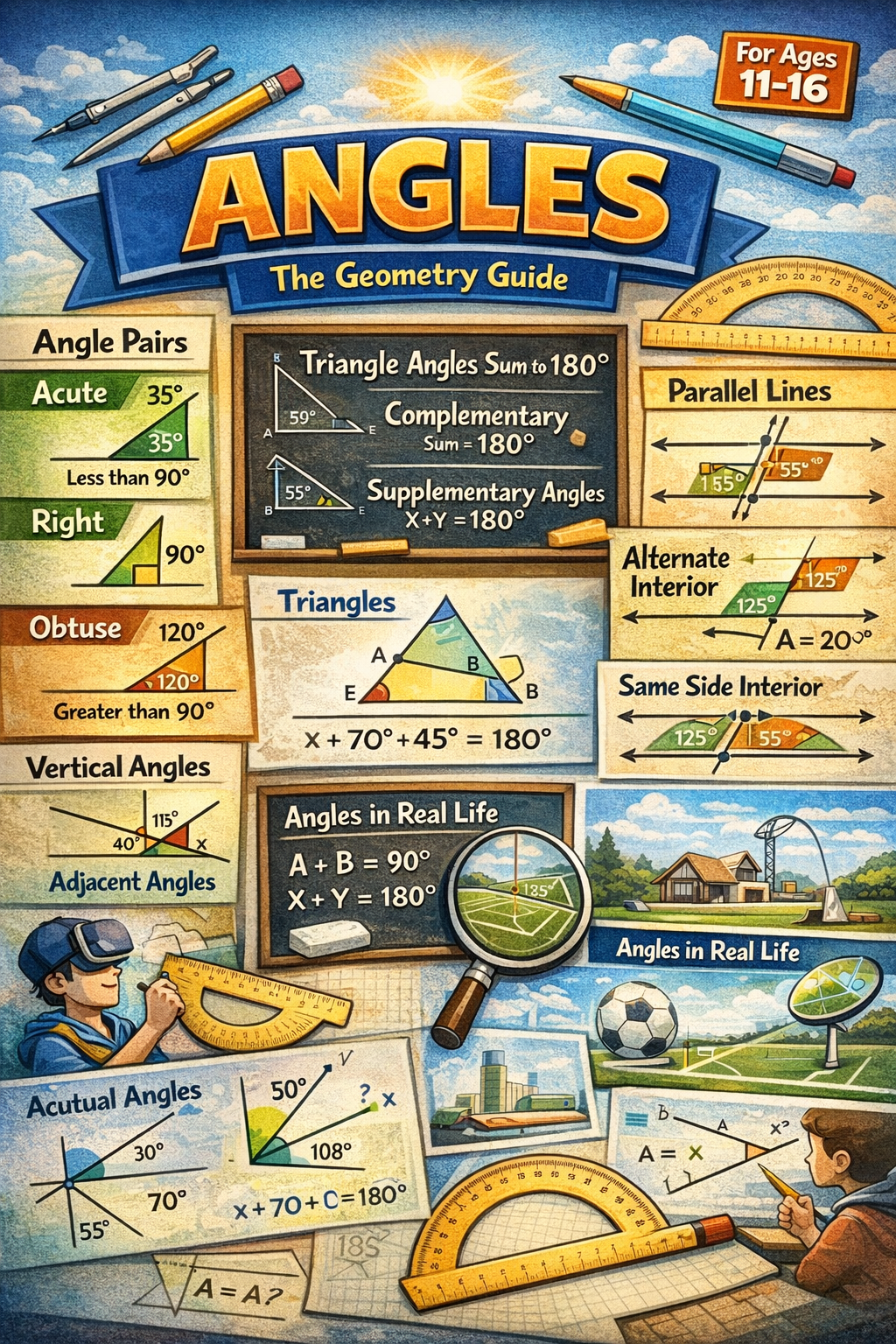
Angles are the quiet superheroes of math. They don’t wear capes, but they control direction, turning, and shape. Every time you rotate your phone screen, take a corner on a bike, aim a soccer pass, or build something in a game, you’re using angles—even if you don’t call them that.
This article is your full angle toolkit: definitions, types, measuring, relationships, and the rules that show up over and over in school. It’s written for students from about 11 to 16, so it starts clean and becomes more advanced step by step. You’ll get mini-challenges, common mistake warnings, and practical ways to solve angle problems like a strategist (not like someone guessing in panic five minutes before the bell).
1) What is an angle, really?
An angle is a measure of rotation (a “turn”). In geometry, an angle is formed when two rays share the same endpoint.
- Rays are like arrows that start at a point and go on forever in one direction.
- The shared endpoint is the vertex.
- The rays are the sides of the angle.
You can name an angle in different ways:
- By its vertex letter: ∠A (if only one angle at A)
- By three letters: ∠BAC (vertex in the middle)
- By a number label: ∠1
Why angles matter
Angles let you describe:
- How “open” a corner is
- How much something turns
- The shape of polygons (triangles, rectangles, etc.)
- The directions in maps, navigation, and robotics
If geometry were a business, angles would be the “strategy team”: they decide where everything points.
2) Measuring angles: degrees and turns
The most common unit is the degree (°).
A full turn around a point is 360°.
A half turn is 180°.
A quarter turn is 90°.
Think of 360° as the “total budget” for one complete rotation.
Protractor basics (how to not get fooled)
A protractor measures angles in degrees. The biggest mistake is reading the wrong scale.
Pro tips:
- Put the protractor’s center point exactly on the vertex.
- Line up one ray with the 0° line.
- Read the scale that starts at 0° on that side.
If your ray lines up with 120° on one side but 60° on the other, the correct one is the scale that started at 0° where you lined it up.
Mini-challenge:
Draw a line, pick a point, and draw a 45° ray using a protractor. Then measure again to confirm. Your goal: accuracy, not speed.
3) The main types of angles (you must know these fast)
3.1) Acute angle
- Greater than 0° and less than 90°
Example: 35°
3.2) Right angle
- Exactly 90°
Looks like a perfect corner. Often marked with a little square.
3.3) Obtuse angle
- Greater than 90° and less than 180°
Example: 140°
3.4) Straight angle
- Exactly 180°
Looks like a straight line.
3.5) Reflex angle
- Greater than 180° and less than 360°
Example: 260° (a big turn)
3.6) Full angle (complete rotation)
- Exactly 360°
Memory hack:
Acute = “a cute little angle.” Obtuse = “obviously bigger.” (Yes, it’s cheesy. It works.)
4) Angle pairs: the relationships that solve most problems
Once you see patterns between angles, problems become plug-and-play.
4.1) Adjacent angles
Two angles that:
- Share a vertex
- Share a side
- Sit next to each other without overlapping
4.2) Vertical angles
When two lines cross, they form an X shape. Opposite angles are vertical angles, and they are always equal.
If you know one, you know the opposite.
Example: If one angle is 70°, the opposite one is also 70°.
4.3) Complementary angles
Two angles that add up to 90°.
Example: 35° and 55° are complementary.
4.4) Supplementary angles
Two angles that add up to 180°.
Example: 110° and 70° are supplementary.
4.5) Linear pair
A special kind of adjacent angles that form a straight line.
They are always supplementary (sum to 180°).
Mini-challenge:
Two angles form a linear pair. One is 128°. What is the other?
Answer: 180° − 128° = 52°.
5) Angle bisectors: splitting angles like a pro
An angle bisector is a ray that divides an angle into two equal angles.
If ∠A is 60° and a bisector splits it, each part is 30°.
Bisectors show up in:
- Construction problems
- Triangle geometry
- Finding centers of shapes
Common mistake:
Students sometimes split the diagram visually instead of splitting the value. Always divide the angle measure by 2, not the “space you think you see.”
6) Parallel lines and transversals: the angle factory
This is the unit where angles become a full-on pattern game.
- Parallel lines never meet (like train tracks).
- A transversal is a line that crosses both.
When a transversal crosses parallel lines, it creates a repeating set of angles. Learning these is a major “level-up” for ages 12–16 geometry.
6.1) Corresponding angles
Angles in the same position at each intersection are equal.
If one corresponding angle is 75°, the matching one is also 75°.
6.2) Alternate interior angles
Inside the parallel lines, on opposite sides of the transversal.
They are equal.
6.3) Alternate exterior angles
Outside the parallel lines, on opposite sides of the transversal.
They are equal.
6.4) Consecutive (same-side) interior angles
Inside the parallel lines, on the same side of the transversal.
They add up to 180° (supplementary).
Strategy tip:
When stuck, label one angle as x, then use equalities and 180° sums to find the rest. The diagram is like a chain reaction.
7) Triangles: angles with strict rules
Triangles are where angle skills become super valuable, because triangle problems are everywhere.
7.1) Triangle angle sum
The interior angles of any triangle add up to:
180°
Always. No exceptions.
If two angles are 50° and 60°, the third is 70°.
7.2) Exterior angle theorem
An exterior angle of a triangle equals the sum of the two remote interior angles (the ones not next to it).
If a triangle has interior angles 40° and 65° (not adjacent to the exterior), then the exterior is 105°.
This is a powerful shortcut in complex diagrams.
7.3) Isosceles triangle angles
In an isosceles triangle, two sides are equal. The angles opposite those sides are equal too.
If two angles are equal and the third is 40°, then the other two must add to 140°, so each is 70°.
7.4) Equilateral triangle
All sides equal, all angles equal:
Each angle = 60°
7.5) Right triangles
If one angle is 90°, the other two must add to 90° (complementary), because total is 180°.
8) Quadrilaterals and polygons: angle budgets get bigger
8.1) Quadrilateral angle sum
A quadrilateral’s interior angles add up to:
360°
Why? It can be split into 2 triangles → 2×180°.
8.2) Polygon interior angle sum
For a polygon with n sides, the sum of interior angles is:
(n − 2) × 180°
Examples:
- Pentagon (5 sides): (5−2)×180 = 540°
- Hexagon (6 sides): 720°
- Octagon (8 sides): 1080°
8.3) Regular polygons
A regular polygon has all equal sides and all equal angles.
Each interior angle:
[(n − 2) × 180°] / n
Each exterior angle:
360° / n
And for convex polygons:
Interior + Exterior = 180°
9) Angles in circles: arcs, chords, and surprising rules
Circles add a new kind of angle magic.
9.1) Central angles
A central angle has its vertex at the center of the circle.
Its measure matches the arc it intercepts.
If a central angle is 80°, the intercepted arc is 80°.
9.2) Inscribed angles
An inscribed angle has its vertex on the circle.
Its measure is half the intercepted arc.
If the arc is 100°, the inscribed angle is 50°.
This rule is extremely common in circle geometry.
9.3) Angles in a semicircle
If an angle is inscribed in a semicircle (endpoints of the diameter), it is a right angle:
90°
That’s a classic result that shows up a lot.
10) Coordinate geometry and slopes: angles meet algebra
For older students (or curious minds), angles connect to slopes.
10.1) Slope basics
Slope measures steepness:
slope = (change in y) / (change in x)
- Positive slope: goes up to the right
- Negative slope: goes down to the right
- Zero slope: flat
- Undefined slope: vertical line
10.2) Perpendicular lines
Two lines are perpendicular if their slopes multiply to −1 (for non-vertical lines).
Example:
Slope 2 and slope −1/2 are perpendicular.
This is angle thinking in disguise: perpendicular means 90° angle.
11) Real-life angle applications (aka “why should I care?”)
Angles are practical, not just academic.
Sports
- Soccer passes and shots depend on angles.
- Basketball bank shots use angle reflection.
- Pool/billiards is basically “angles: the game.”
Engineering and architecture
- Roof angles determine drainage and strength.
- Triangular supports stabilize structures.
- Bridges use angle-based trusses to distribute force.
Game design and 3D graphics
- 3D models are built from triangles (polygons).
- Camera angles change how a scene feels.
- Rotations in games are literally angle measures.
Robotics and navigation
- Robots turn by degrees.
- GPS directions and bearings rely on angles.
- Drones adjust angles for stability.
Angles are the “steering wheel” of the physical and digital world.
12) The angle-solving playbook (how to win tests)
When you see a messy diagram, don’t panic. Run this checklist:
- Mark what you know. Write the given measures.
- Spot the structure. Is it:
- intersecting lines? (vertical + linear pairs)
- parallel lines? (corresponding/alternate/same-side)
- triangle? (sum 180 + exterior theorem)
- polygon? (angle sum formula)
- circle? (inscribed = half arc)
- Use the angle budget.
- Straight line = 180°
- Full turn = 360°
- Triangle = 180°
- Quadrilateral = 360°
- Do a sanity check.
- Acute should be <90
- Obtuse between 90 and 180
- Reflex >180
If your “acute angle” becomes 143°, you took a wrong turn.
This is business logic for math: identify the model, apply the rule, validate output.
13) Common mistakes (so you don’t step on the same rakes)
- Reading the wrong protractor scale
Always start at 0° on the aligned ray. - Assuming angles are equal because they “look equal”
Diagrams are not always drawn to scale. Trust rules, not vibes. - Confusing complementary and supplementary
- Complementary → 90
- Supplementary → 180
- Mixing up angle types in parallel lines
Label positions carefully. Corresponding are “same spot.” - Forgetting triangles sum to 180
This is the #1 triangle rule. If you forget it, everything collapses.
14) Practice section (with quick answers)
A) Basic types
- Is 87° acute, right, obtuse, straight, reflex?
Acute. - Is 145° acute, right, obtuse, straight, reflex?
Obtuse. - Is 200° acute, right, obtuse, straight, reflex?
Reflex.
B) Complementary & supplementary
- Complement of 63° = 27°
- Supplement of 117° = 63°
C) Intersecting lines
- If two lines cross and one angle is 38°, the vertical angle is 38°, and the adjacent linear pair is 142°.
D) Triangle
- Angles are 45° and 70°. Third = 65°.
E) Parallel lines (conceptual)
- If corresponding angles are equal and one is 112°, the corresponding one is 112°.
Then adjacent angles on a straight line are 68°.
15) Challenge problems (stretch level)
- A triangle has an exterior angle of 130° and one remote interior angle of 55°. Find the other remote interior angle.
130 = 55 + x → x = 75°. - A regular polygon has exterior angles of 20°. How many sides?
360/n = 20 → n = 18. - Two parallel lines are cut by a transversal. A consecutive interior angle is 103°. Find the adjacent consecutive interior angle.
180 − 103 = 77°. - In a circle, an inscribed angle intercepts an arc of 146°. Find the inscribed angle.
146/2 = 73°.
If you can do these, you’re not just passing—you’re controlling the room.
16) Tiny glossary (fast definitions)
- Angle: measure of a turn between two rays
- Vertex: point where rays meet
- Ray: line starting at a point, extending forever
- Adjacent angles: share side and vertex
- Vertical angles: opposite angles when lines cross (equal)
- Complementary: sum to 90°
- Supplementary: sum to 180°
- Transversal: line crossing two lines
- Corresponding angles: same position (equal if lines parallel)
- Alternate interior: inside, opposite sides (equal if lines parallel)
- Consecutive interior: inside, same side (sum 180 if lines parallel)
- Inscribed angle: vertex on circle (half intercepted arc)